

VRF Randomness
TRTH uses Chainlink VRF v2.5 so that Bonus multipliers and King selection are not opaque off-chain rolls. Randomness is requested on-chain, fulfilled by the VRF coordinator, and consumed by protocol logic through a narrow adapter boundary.
Why VRF matters
Section titled “Why VRF matters”Bonus needs a high-entropy seed to define a random multiplier window each epoch. King needs unpredictable selection among eligible holders. A centralized server could inject bias or censor outcomes; Chainlink VRF provides verifiable randomness tied to on-chain proofs.
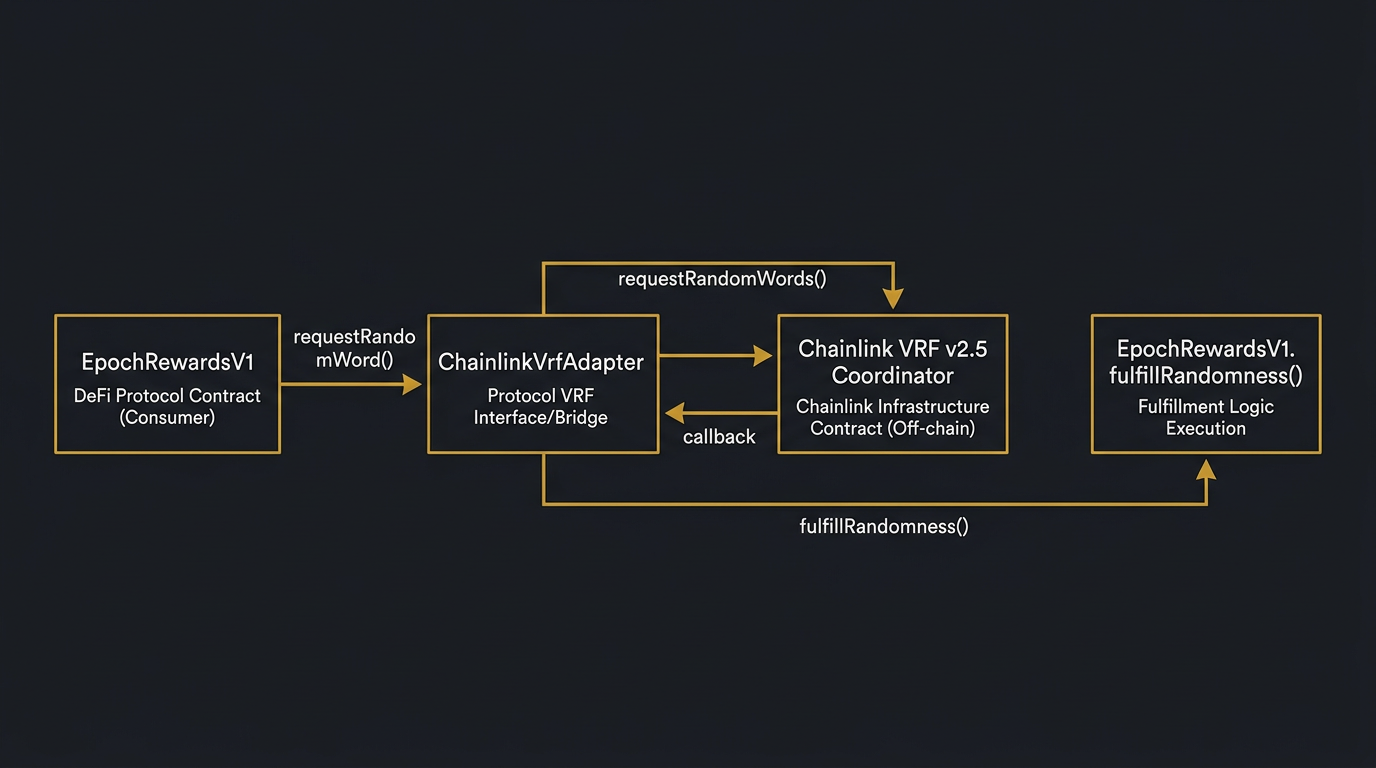
Contracts and adapter pattern
Section titled “Contracts and adapter pattern”The typical call chain is:
EpochRewardsV1_1 → ChainlinkVrfWordAdapter → Chainlink VRF v2.5 Coordinator → callback → fulfillRandomness()
EpochRewardsV1_1owns epoch accounting and knows when a new random word is needed.ChainlinkVrfWordAdapterisolates VRF subscription, key hash, callback gas, and request ID plumbing from the rest of the rewards logic.- The Coordinator is the Chainlink VRF v2.5 contract that validates proofs and delivers random words.
This adapter pattern keeps rewards code readable: domain rules stay in EpochRewards, while VRF-specific details stay in the adapter.
Request lifecycle
Section titled “Request lifecycle”- Trigger: The protocol (often a keeper or permissioned cron) observes that an epoch needs randomness — e.g., Bonus or King settlement for a completed window.
- Request:
EpochRewardsV1_1asks the adapter torequestRandomWords(or equivalent) on the Coordinator, paying LINK (or the configured billing path) from the subscription. - Pending state: The request is asynchronous. Callbacks arrive in a later transaction, possibly minutes later depending on network and VRF load.
Fulfillment lifecycle
Section titled “Fulfillment lifecycle”- Fulfill: The Coordinator calls the adapter’s callback with random words and proof validation performed by Chainlink infrastructure.
fulfillRandomness: The adapter forwards the word(s) toEpochRewardsV1_1, which splits the entropy:- Bonus seed: derives parameters for the random multiplier window for eligible holders.
- King selection: maps entropy to one eligible holder for the 10% King slice (subject to eligibility and lag rules described in Epochs & Rewards).
Operational expectations
Section titled “Operational expectations”VRF introduces latency and LINK economics: requests can fail or stall if subscriptions are underfunded or limits are misconfigured. Ops must monitor subscription balance and fulfillment events.
In short: EpochRewards orchestrates when randomness is needed; Chainlink VRF v2.5 provides verifiable words; fulfillRandomness binds those words to Bonus and King outcomes.