

Fee Sink
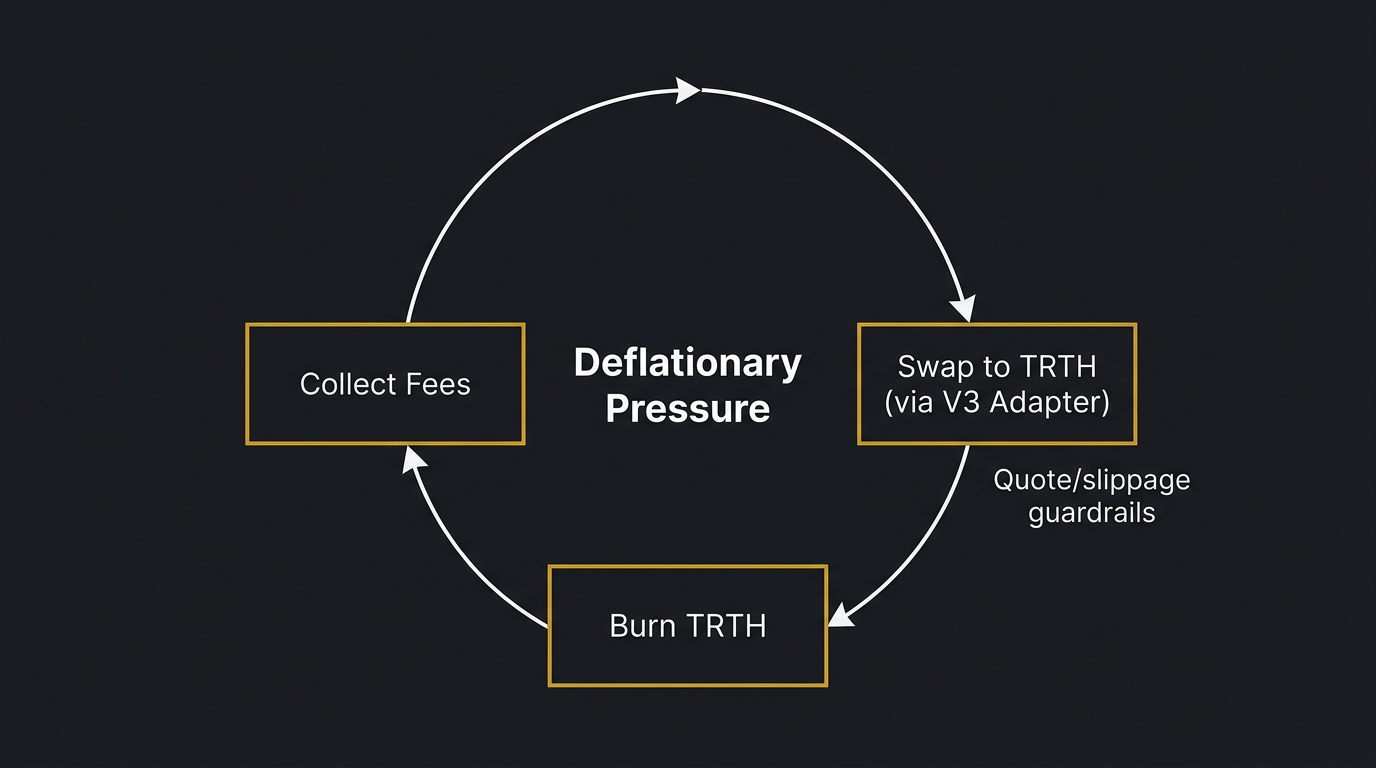
The FeeSink recycles protocol-accumulated fee assets into TRTH and burns them, creating deflationary pressure alongside emissions. Instead of letting miscellaneous tokens pile up inertly in a vault, the system periodically routes value toward scarcity for the native token.
Fee collection
Section titled “Fee collection”Fee tokens arrive from configured sources (pairs, routers, periphery integrations, or treasury sweep paths, depending on deployment). They may accrue in the sink contract or be pushed there by permissioned keepers. Batching fee inventory before swapping simplifies routing and gas when converting many small balances into one TRTH burn.
Swap adapter: V4FeeSinkSwapAdapter
Section titled “Swap adapter: V4FeeSinkSwapAdapter”Swaps execute through V4FeeSinkSwapAdapter, which speaks Uniswap V4 paths: it quotes candidate routes, executes swaps on-chain, and returns TRTH to the burn path. Pool fee tiers and path topology follow whatever configuration the adapter was given at deployment.
Quotes and slippage guardrails
Section titled “Quotes and slippage guardrails”Before settling, the adapter checks quotes against on-chain or peripheral pricing and enforces minimum output amounts — slippage guardrails that reject trades when sandwich risk or misconfiguration would deliver too little TRTH for the burn. That protects treasury inventory from obviously bad fills.
Burn and deflation
Section titled “Burn and deflation”Successful swaps hand TRTH to the burn path — the FeeSink burns the acquired TRTH via the token’s public burn() — removing supply from circulation. Sustained fee flow therefore pairs recurring buy-side routing with permanent reduction — the counterweight that shrinks circulating supply below the fixed, pre-minted 21M cap.
In short: FeeSink collects external value, converts it to TRTH under guards, and burns — tying protocol usage to long-run scarcity.