

How It Works
TRTH follows a lifecycle: bootstrap liquidity and supply, then run weekly epochs with on-chain randomness and deflationary pressure via the FeeSink.
1. Genesis — deposit USDC
Section titled “1. Genesis — deposit USDC”Genesis is the initial alignment phase: users deposit USDC, and when the phase finalizes, TRTH is batch-distributed pro-rata via permissionless processBatch (no separate user claim for Genesis TRTH). Bootstrapable USDC (deposits minus pending referral obligations) seeds Uniswap V4 liquidity so TRTH can trade with depth at launch.
2. Token distribution — fixed cap, clear buckets
Section titled “2. Token distribution — fixed cap, clear buckets”TRTH is an ERC-20 with a 21,000,000 cap—no infinite mint. Supply splits across genesis, LP bootstrap, and the emission pool so later rewards stay funded. After finalization, holders custody TRTH on Base and move into epochs.
3. Weekly epochs — Base, Bonus, and King rewards
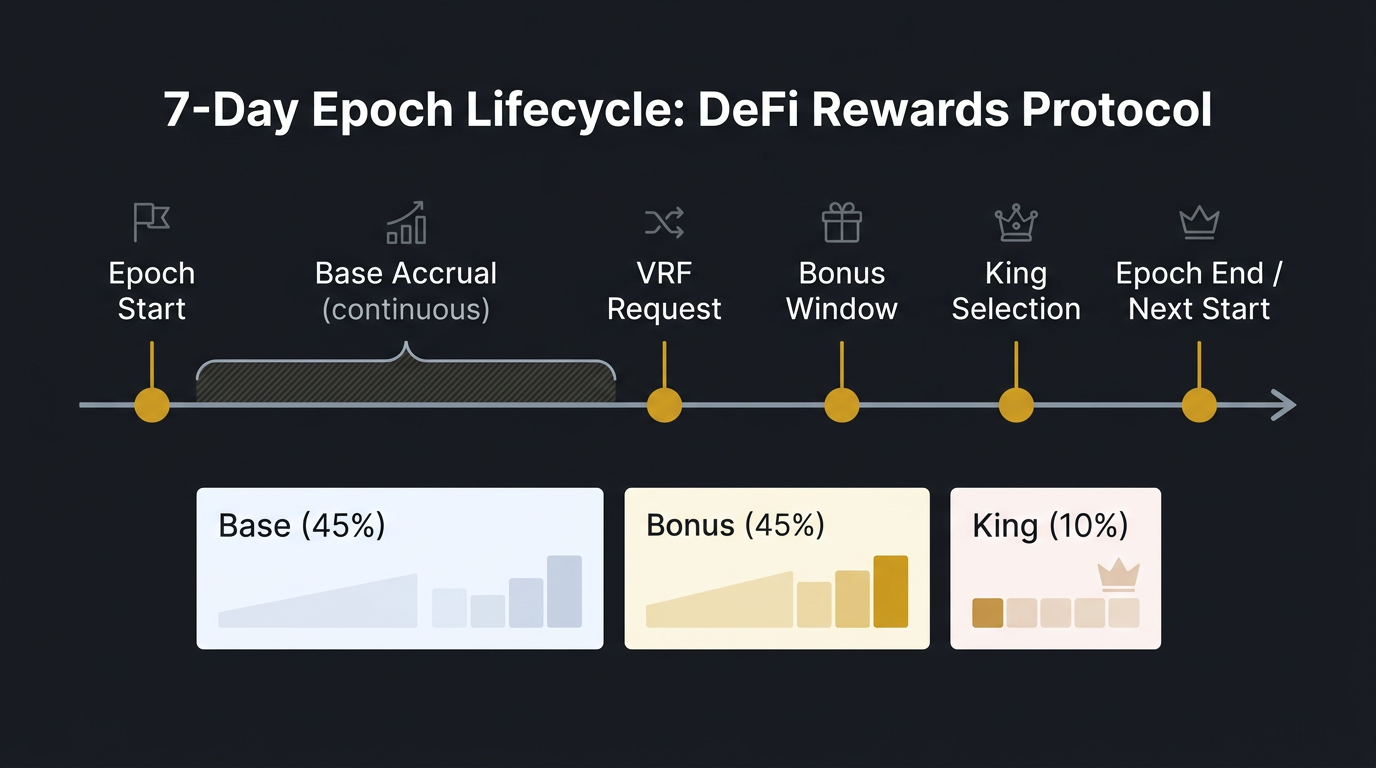
Section titled “3. Weekly epochs — Base, Bonus, and King rewards”Once TRTH is circulating, the protocol shifts into weekly epochs. Each epoch allocates rewards from the emission design across three buckets that split the weekly reward budget:
- Base (45%) — the steady, broad layer for participants who meet the baseline epoch rules.
- Bonus (45%) — extra upside tied to epoch mechanics, eligibility windows, and protocol-defined qualifiers.
- King (10%) — a smaller, prestige-style slice associated with standout epoch outcomes.
Together, 45% + 45% + 10% keeps most rewards in Base and Bonus, while reserving a King lane for top-tier results.
You earn by holding and qualifying under the epoch rules (see contracts and app for eligibility). Think in weeks: rewards accrue per epoch, not as a one-off airdrop.
4. VRF randomness — verifiable “luck”
Section titled “4. VRF randomness — verifiable “luck””Bonus and King-style outcomes use randomness, but TRTH does not rely on a private server seed. Chainlink VRF v2.5 flows through an adapter contract, so random words are provable on-chain with explicit request/fulfill flows. Anyone can audit the same inputs and outputs the contracts consumed—not “trust our RNG.”
5. FeeSink — buyback, burn, deflation
Section titled “5. FeeSink — buyback, burn, deflation”Fees routed through the FeeSink can fuel buyback and burn, adding deflationary pressure on the fixed supply as activity grows. When the ecosystem generates real fee flow, the protocol can recycle value into supply reduction, complementing the emission schedule instead of pretending emissions do not exist.
Epoch lifecycle at a glance
Section titled “Epoch lifecycle at a glance”The diagram below ties together Genesis deposits, weekly epochs, VRF-driven outcomes, and FeeSink recycling.
Off-chain services
Section titled “Off-chain services”Smart contracts remain the source of truth, but three services keep the product usable day to day: an Orchestrator (keeper-style) submits time-sensitive transactions, an Indexer aggregates balances and history for the UI, and a Proof-API helps clients validate claims and proofs. Everything runs against Base mainnet or Base Sepolia for testing—without moving settlement or VRF off-chain.