

Genesis
Genesis is TRTH’s structured launch phase: participants deposit a base asset (typically USDC on Base) under transparent rules, then receive TRTH after finalization according to pro-rata shares. Referral incentives accrue in the base asset.
Deposits and the base asset
Section titled “Deposits and the base asset”Users deposit the configured base asset into GenesisV1_1. Deposits are tracked so the contract can compute each address’s share of the genesis pool at settlement. Optional GenesisZapIn / GenesisReferralZapOut contracts may be deployed and role-granted for routed deposits/claims when enabled for a given deployment; the primary path remains a direct deposit into Genesis.
The interface should always show network, token, and allowance clearly — Genesis is non-custodial in the usual DeFi sense (you approve and interact with contracts), but irreversible on-chain once executed.
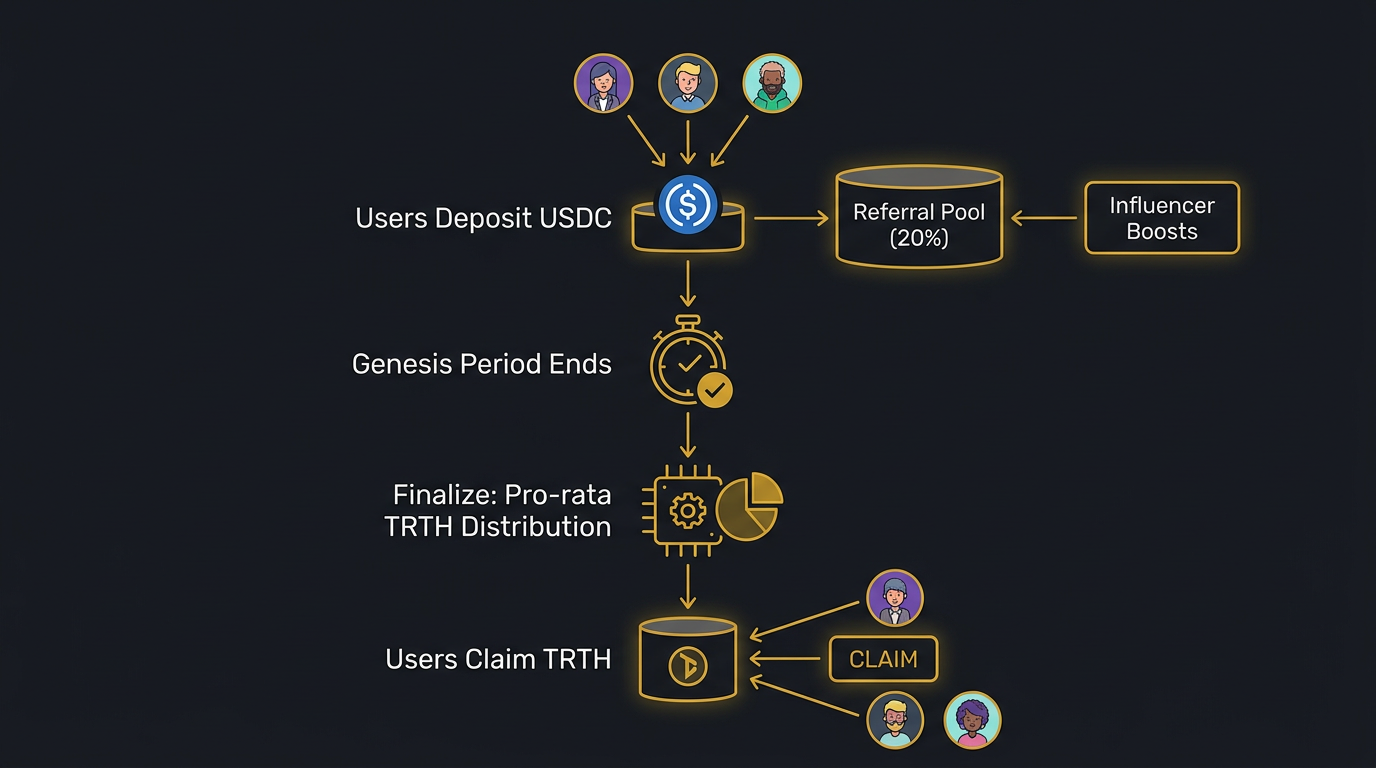
Referral pool (20% / 2000 BPS cap)
Section titled “Referral pool (20% / 2000 BPS cap)”Each deposit reserves up to 20% (2000 BPS) as a referral pool cap. Standard referral tiers from that cap are:
- Level 1 (direct): 8% (800 BPS)
- Level 2: 5% (500 BPS)
- Level 3: 2% (200 BPS)
Influencer status can raise those rates (on-chain boosts). Accrued referral rewards sit in referralPending and are claimed in the base asset via claimReferralAll after finalization.
Bootstrapable balance (not a fixed 80/20 split)
Section titled “Bootstrapable balance (not a fixed 80/20 split)”Liquidity bootstrap does not take a hard-coded 80% of all deposits. On-chain:
bootstrapableBalance = contract balance − totalReferralPending
So:
- Accrued referral obligations stay reserved for referrers.
- Everything else — including unused referral cap — remains bootstrapable for the Uniswap V4 LP seed (paired with the pre-funded 525,000 TRTH LP budget).
Influencer tiers
Section titled “Influencer tiers”Influencer tiers raise referral BPS for designated addresses. Tiers align distribution with participants who grow the community without changing the underlying deposit accounting ordinary users see.
Finalization and batch TRTH distribution
Section titled “Finalization and batch TRTH distribution”When Genesis finalizes, the protocol closes new deposits, fixes accounting totals, and enables batch distribution of the 525,000 TRTH Genesis budget.
TRTH is pushed to participants via the permissionless function:
processBatch(n)
There is no user claimTRTH() step. Anyone can call processBatch to distribute the next n recipients pro-rata. Recipients receive TRTH by transfer from the Genesis contract’s pre-funded balance (the full 21M supply was pre-minted at deploy; Genesis was funded with 525k TRTH).
Pro-rata TRTH
Section titled “Pro-rata TRTH”After finalization, TRTH is allocated pro-rata to depositors:
entitlement = GENESIS_USERS_BUDGET × (userDeposit / totalDeposits)
Together, base-asset deposits, capped referral economics, tiered influencers, and batched, pro-rata TRTH distribution form the on-ramp from stablecoin participation to long-term epoch rewards.