

Tokenomics
TRTH (TruthBTC) is an ERC-20 on Base with a hard cap of 21,000,000 TRTH. No inflation beyond that ceiling: the entire supply is pre-minted once at deployment and the token has no minter roles, so the cap is the single source of truth for long-term scarcity — supply can only stay flat or shrink (via burns).
Supply cap and distribution
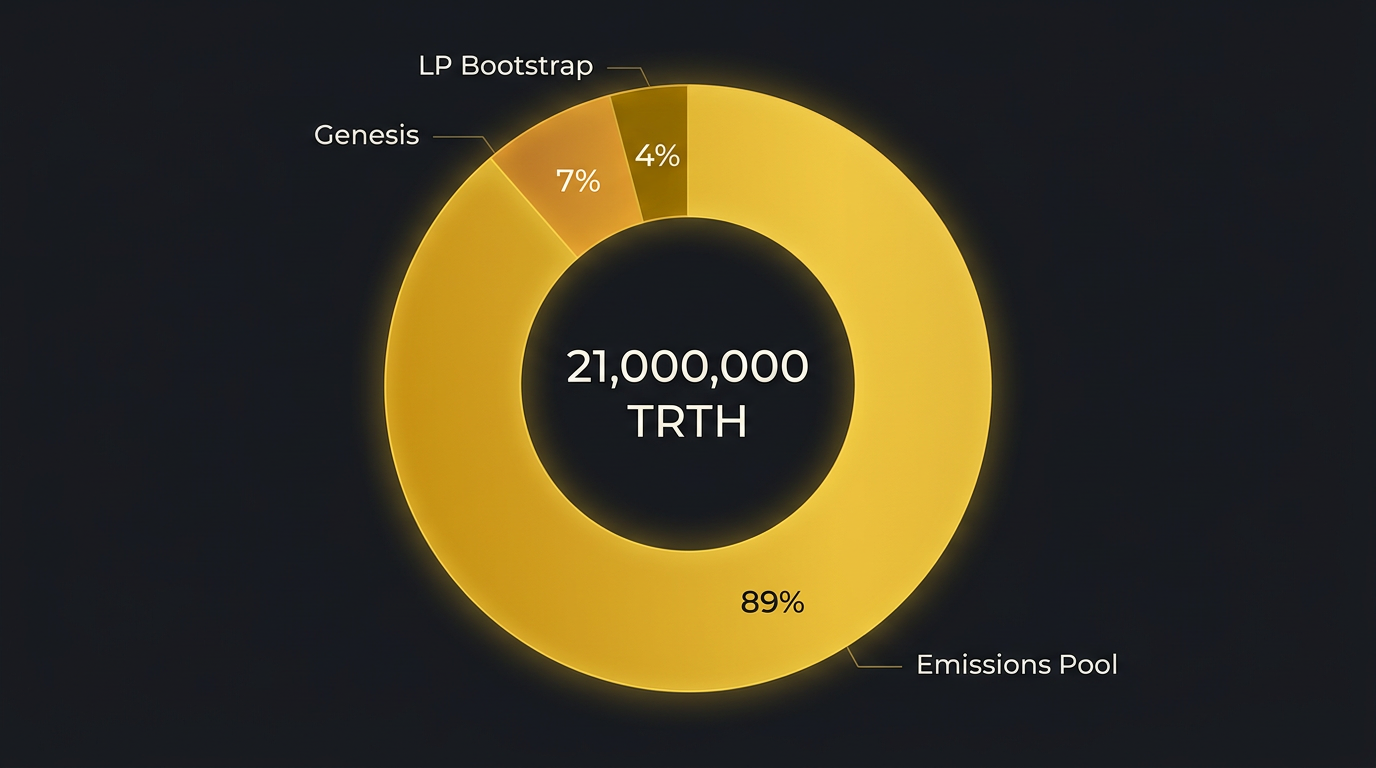
Section titled “Supply cap and distribution”The full supply is partitioned into three buckets:
- Genesis — 2.5% (525,000 TRTH): allocated through the Genesis phase (deposits, finalization, and distribution mechanics described in the Genesis section).
- Liquidity bootstrap — 2.5% (525,000 TRTH): reserved for one-shot liquidity creation tied to the bootstrap flow.
- Emissions — 95% (19,950,000 TRTH): released over time through the weekly epoch reward system, governed by the emission schedule and era-based decay.
Because the full supply is minted up front, each bucket is funded by a one-time transfer of pre-minted TRTH to the relevant contract — the emission pool to EpochRewardsV1_1, the Genesis allocation to Genesis, and the LP allocation to LiquidityBootstrap. Those contracts then distribute by transfer (rewards claims, pro-rata Genesis payouts, LP seeding) rather than minting new tokens. With no minter roles and a fixed pre-minted supply, there is no hidden inflation lever — every movement is an auditable transfer bounded by the 21,000,000 cap.
Emission schedule and eras
Section titled “Emission schedule and eras”Rewards are organized in 7-day epochs. The protocol also defines an era length of 31 days as the conceptual frame for long-horizon emission decay (the “era-based schedule”). In the current deployment, the active model is weekly-only: epochs tick every seven days, while the era construct describes how the schedule is designed to taper when that mode is enabled — aligning long-run emissions with participation rather than a flat perpetual drip.
Deflationary pressure: Fee Sink
Section titled “Deflationary pressure: Fee Sink”Emissions answer “how TRTH is distributed over time.” The Fee Sink answers “how circulating supply can shrink again.” Protocol fees (or fee-like tokens) are collected, swapped toward TRTH through a Uniswap V4–based adapter with guards, and burned. That loop ties activity and fee flow to reduced circulating supply, complementing the fixed cap with ongoing, usage-linked deflationary pressure.
In summary: 21M max supply, a small genesis and LP slice, the majority in emissions, and a fee-driven burn path that can offset issuance over the long run as the ecosystem grows.